Saturday, April 29, 2006

Vincent Van Gogh who lusted for life

Title: Lust For Life
Author: Irving Stone
Pages: 423
Publishers: Arrow Books
1st edition: 1935
17th edition: 2001

Lust For Life is a biographical novel which deals with the life of the famous artist Vincent Van Gogh, his trials, tribulations and paintings. Author Irving Stone has written this after extensive research and has referred innumberable letters of Vincent Van Gogh. I knew that Van Gogh was a great artist but never knew anything else about him. I felt wretched throughout the book and never wanted to continue further, but I kept myself pushing till the end.

Van Gogh sold only one painting during his brief lifetime and all along he battled violently with the thought that he is a wastrel, being an artist, whose paintings are crude, ugly and unsaleable. No matter how he screwed up his own life, his younger brother Theo, stood by him as a rock, supporting him throughout his barbarious stint with painting.

My rational mind kept on cursing Vincent Van Gogh for all the blunders he was creating for himself which were completely unnecessary and stupid. Only when Vincent saw his brother crumble did he lose hope and end his life. I still can't stomach the fact that a person can go through such disasters and personal upheavals in life which are self-made.

Vincent's stay in Paris with his brother was the only time I enjoyed the read. He was very mercurial in nature when it came to sticking to one particular place. He would long to go to some place after hearing good things about it; he enjoyed the stay there for a brief while and after sometime would screw up things and make them so ugly that he was forced to get out of there. He had a knack to f*** up things. The cruel irony about him is that he was a failed man who was self-destructive and became a great artist only after his death.

Well, here are some of the quotes which I liked in the book.

You can never be sure about anything for all time. You can only have the courage and strength to do what you think is right. It may turn out to be wrong, but you will atleast have done it, and that is important thing - page 42

Many a times in your life you may think you are failing, but ultimately you will express yourself and that expression will justify your life - page 43

Perhaps God knows, and then again he doesn't - page 83

He who loves lives, he who lives works, and he who works has bread - page 137

Human conduct is a great deal like drawing. The whole perspective changes with the shifted position of the eye, and depends not on the subject, but on the man who is looking - page 197

It is the plight of most people that by a kind of fatality they have to seek a long time for light - page 234

Religion will never get people anywhere. Only the base in spirit will accept misery in this world for the promise of bliss in the next - page 297

The public cannot understand that there is no room for moral judgements in art. Art is amoral; so is life - page 299

The ordinary human brain thinks in terms of duality; light and shade, sweet and sour, good and evil. That duality does not exist in nature. There is neither good nor evil in the world, but only being and doing - page 299

There is pleasure, sure, in being mad, which none but madman knows - page 392

Aristotle said, 'no excellent soul is exempt from a mixture of madness! - page 412

Tuesday, March 28, 2006

Holy Man on Chamundi Hill


I had been to Chamundi hill recently to click some snaps. While I went around the temple I saw this old man with saffron robes, red uttareeya, matted braid fastened with rubber-bands, and a Santa-esque white beard. He had this biggest and roundest red bindi on his broad forehead which gave him a very attractive look. He was sitting in front of Sri Narayana Swamy temple and was having his brunch out of a stainless steel dabari.

I couldn't resist the temptation and requested him to pose for me. Without the slightest hint of annoyance, for being disturbed, he obliged and posed for me. I took a few snaps, one of which is displayed here. I call him, the 'Holy man of Chamundi'.

Tuesday, March 21, 2006

Mysore to Srirangapatna in style

Since a couple of years I used to dread going to Srirangapatna. Invariably the travel was by road and the mere thought of it sent shivers down my spine. The widening and four-laning of the Mysore - Bangalore road was progressing at a snail's pace and all the ancient trees that flanked the picturesque road were sacrificed at the altar of progress. The road was dug up everywhere.

The Mysore - Bangalore Highway cuts through vast tracts of farm lands and lot of natural and manmade water bodies flow across it, at regular intervals, to quench these fields. So numerous small bridges have been built including a couple of huge bridges across river Cauvery. Redoing the entire road meant re-building these bridges too. So there were lot of traffic bottle necks at the bridges that were under construction.

Inspite of the dug up road, torned down bridges, the bottle necks, uprooted trees, huge potholes, littered boulders, maddening traffic, choking fuel fumes, etc., many a daredevils zipped through the pathetic thing that once used to be a shady, cool road, with least concern to themselves and their fellow road users.

But yesterday noon when I drove from Mysore to Srirangapatna, I felt like whistling all the way.

Yes, there are no more trees that once flanked a narrow road, but there is this beautiful four-lane road which has a central divider planted with bougainvillae, hibiscus, and other flowering plants. One need not stress himself thinking about the trucks and KSRTC buses hurtling towards from the opposite direction. The road is smooth and stylish (except at the couple of places where the major bridges across Cauvery are under construction). Feels good to drive. I agree that it is no match to the Delhi-Noida expressway that I got a chance to blaze through sitting at the back of the car a couple of years ago, but the new road certainly provides a faster connectivity to road users between Mysore and Bangalore.

Watch out Bangalore! Mysore has come closer to you...

Sunday, March 12, 2006

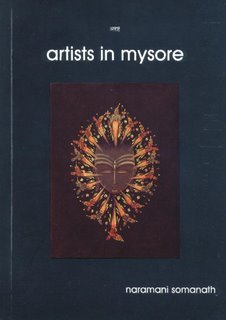
Review of the Book - Artists in Mysore


Artists in Mysore is a book authored by Naramani Somanath. As the title suggests the author has written on twenty-three artists of Mysore. The Majority of the artists featured are painters in various styles while a few marquetry artists, an avantgarde non-narrative film maker, two poets, a photographer and an architect are also featured. The author explores the respective art practised by each artist and also touches upon the various social and cultural aspects in relation to the artist, there by giving a commentary on their artistic lives without being categorical.

The selection of the artists is not deliberate but rather a random choice, says the author in his introduction. The book begins with K.S. Shreehari. Even though there are many artists painting in Mysore style, the author refers to Shreehari as being the last of our traditional Mysore school painters because he has learned the art in the same old traditional way from his father and grand-father as they did from their’s. The author disapproves other ways of learning this art which is mere copying.

Mysore is quite well-known for its marquetry tradition which is derived from the Italian renaissance. So the author has deemed it fit to include three artists who pratice this art. V.M. Sholapurkar, the former Dean of CAVA deals with marquetry in the sense of ‘modern art’. K. Mohan of Mandi Mohalla has been trained under the traditional masters of inlay and his pictorial marquetry is quite appealing to the author. Eric Sakellaropoulos, a greek, hails from Canada. He has set up a workshop in Mysore and producing marquetry pieces. He is almost renewing the aesthetic of pattern marquetry with his designs.

Vishnudas Ramdas and Raghuttama Putty, both senior artists are the pride of Mysore. Ramdas is an acclaimed portrait artist who has designed more than 35 gardens across India. His contribution to the horticultural architecture remains unknown for us Mysoreans. And as for Putty, he is the oldest living artist of Mysore who still paints at the ripe age of 92. He recently exhibited his landscapes on his 91st birthday.

Girija Madhavan brings a remarkable Japanese sensitivity to her work. She learned under many people around the world and each of her paintings is a masterpiece of vision, skill and sensitivity. Her mother, Mukta Venkatesh, wiled away her hundred years on the flowers of Mysore. Our city still has what must surely be the most beautiful flowering trees in the world. Mukta used to draw and paint flowers as a detailed study.

Two artists of Srilanka who have now adopted Mysore as their home are also featured in this book. Druvinka attended Shantiniketan and fell for the charms of Mysore which rarely stirs up any emotion in we Mysoreans. She paints in several layers of different colours, one upon the other, until the painting looks greyish with hints of colours, underneath, peeping through here and there. Her brother, Shehan Madawela who is residing here since 11 years, is inspired by the local women, the flowers, the food and the light. The faces in his paintings are stark and haunting.

G.L.N. Simha is an artist on his terms. He should be happy with his painting first before anyone else sees it or else the painting never sees the daylight again. The author understands the training tradition Simha has gone through and has made a brief study of this in the article.

M. Nagaraja Sharma is an archaeologist and a photographer. Along with him, the Venezuelan poet Rowena Hill and the wellknown poet Mudnakudu Chinnaswamy are featured in the book.

N. Sjoman, is an artist with a sense of humour and a Sanskrit scholar. A Canadian national, he is in love with Mysore for the past three decades. His works are personal statements and take a dig at the existing double standards in the society. He is a writer himself and has co-authored the book ‘Yoga Touchstone’ along with H.V. Dattatreya.

The only architect to be featured in the book, Shashi Bhooshan brought a new aesthetic to the otherwise languishing building architecture of Mysore which once boasted of lovingly built beautiful houses, buildings and palaces.

Though trained in a traditional idiom, Raghupati Bhatta has explored outside the tradition and has been successful in creating tiny worlds within the stifling spaces of narrow cards. Deft strokes of colours transform magically into forms and figures. One of his Visvarupa paintings grace the cover of the book.

N.S. Harsha is a rising star on the horizon of ‘modern art’ and Mysoreans hardly take stock of his creativity. He derives his aesthetics from Mysore, its creatures and contents. A student of CAVA, his paintings and installations are sought after around the globe.

Sami Vaningen is a contemporary art film maker who keeps returning to Mysore, the city where he grew up. Among his 15 films few were shot in Mysore. Another former Dean of CAVA to be featured in this book is Ramdas Adyanthaya. He paints from his experiences in life rather than from academic training.

Babu Eshwar Prasad is articulate about his art. You can read about him in his own words in the book. The article on Penpa Yaasel opens a whole new canvas of Tibetan thangkas. It also juxtaposes the two worlds of Tibetans - their life within Tibet and the other, without.

Pinki hails from the land of Madhubani and Mithila paintings. Her paintings are a mirror to her ecstasy during her creative trance. She is an artist for art’s sake and her art spills out of the canvas into her immediate physical world.

This book is a very informative one on artists in Mysore and a pleasure to read. It opens up a whole new perspective on an undisclosed world in Mysore. Every now and then Mysore, sort of, peeps out from the book and shows a stark fact about itself which the reader cannot ignore. It is as if a single thread of Mysore’s contemporary story is told through the lives of twenty-three artists. It’s like watching a TV with Picture-in-Picture facility - you are watching a channel, you switch on a small window in a corner of the monitor and take a peek at another channel as well. And when the reader finally turns the last page he yearns for more of Mysore and more artists.

One thing that the book really awakens, a regular Mysorean, to is the fact that there are so many artists enchanted with the city’s charm. They are unseen and unheard of. They remain in the background and work like shadows lurking in the dark deep recesses of the city.

In the beginning the reader may feel a little uncomfortable with the style of Naramani. He at times seems to wander off somewhere which is unconnected with the immediate context but when he returns to the original narrative the reader is surprised when that ‘stray-off’ blends so perfectly with the original context giving it a whole new meaning.

The book contains a picture of the work of each artist and at the back, there is a CD with additional pictures on it. Like this the reader can have a broad view of the work at a relatively low cost. This book, published by the Black Lotus Books Inc., Calgary, Canada, is a snapshot of arts of Mysore in the year 2006.

Tuesday, October 18, 2005

Bombe Mane - The Doll House

Come Dasara and Mysore becomes a bustling centre of festivities, fun and fantasy. Every night during these 10 days, a gargantuan incandescent word in Kannada - Susvaagata(meaning Welcome) - appears magically on the dark south-eastern skyline of the city where during the daylight one would have seen the expansive Chamundi Hill, the silent sentinel of the city. This is how Mysore welcomes its guests during this festive season.

But no such visual invitation is required to go to any stranger's house these days as you can just walk into any house in the evening if the dolls are arranged in that house. Every house, literally, becomes a doll house for 10 days. Dolls that are being collected since generations are taken out from wooden chests, almirahs, lofts and showcases; they are diligently dusted, and neatly arranged on temporary wooden steps that would have been constructed beforehand.

Pattada Gombe, a pair of dolls (King & Queen) carved out of the rare red sandalwood, are placed at the summit of the arrangement, while other dolls occupy lower steps. Dolls of every hue and mood vye for the attention of the onlooker and thereby taking him back to the magical world of innocence.

Tuesday, September 13, 2005

Sri Rama - The Best Among Men

Me and my siblings have been fed with Ramayana, Mahabharatha and other stories by my granny since we were kids. She was a storehouse of myths, legends, Puranas and fairy tales. Like a TV soap opera she narrated the stories daily at bedtime and kept us five siblings from bothering our Mom. Thanks to her, though I haven't read the epics myself, I know the entire story and the characters in them by heart.

In Ramayana, the interesting part for me after the death of Ravana was the 'Agni-pareeksha' of Seetha. I was more fascinated with the miracle of fire not burning Seetha. The kid in me was engrossed in the fantastic nature rather than dwelling on the harsh realities.

As time flew by and the stories became more real than fantasy, I started looking for human stories in these larger than life epics. Enquiry replaced wonder. Questions replaced blind belief.

I am a believer in God and my personal prayer involved Lord Sri Rama among few other deities. But since couple of years I am unable to think of Sri Rama as my ideal, because he betrayed Seetha. He left her high and dry when she needed him the most.

During the hindu wedding rituals, the bride and groom take a vow, of togetherness, with sacred fire 'agni' as the witness. Rama married Seetha by promising in front of 'agni' that he will always be there with her in happiness or illness, taking care of her well being.

He went to great lengths to keep the word of his father, but when it came to himself, he turned a blind eye, abandoned the promise made in front of 'agni' and casted away a pregnant Seetha into the wilderness to the mercy of wild beasts.

To fulfill his father's promise, Rama went into exile for 14 years. He was supposed to go alone, but Seetha followed him when she, instead, could've opted to stay in the palace. She endured the hardships just to be with her beloved. She was kidnapped by Ravana and suffered great misery but the hope that Rama will come and rescue her saw her through that misery. Surely Rama came, fought Ravana and killed him only to plunge Seetha into the fire.

Rama, who once with the mere touch of his toe relieved Ahalya off her curse, now wanted Seetha to convince him of her chastity and asked her to purify herself by entering the fire. Even fire couldn't harm her and Rama, now convinced, took her back, returned to Ayodhya and was enthroned. All's well that ends well, we thought, until a washerman cast aspersions on Seetha. That's it, Rama had to dump Seetha at any cost because one of his subjects doubted the queen.

Seetha, who was pregnant at that time is not even given an explanation or a hint about what was coming her way. The least suspecting Seetha is taken to the edge of the forest and dumped there unceremoniously.

For Rama, the word of his subject is far more important than the word he had given his wife during the wedding; by sending away Seetha he was only endorsing the view of the washerman. If he was so much concerned with the washerman's words, he could have abdicated the throne, but no! He would rather dump his wife than give away the throne.

Rama questioned the chastity of his wife, took her trial by fire, betrayed the promise given to her and dumped her acknowledging a hearsay. Can you call him 'Maryada Purushottama?'

ಪಾದಸ್ಪರ್ಶದಿ ಶಿಲೆ ಸಾಧ್ವಿಯಾದಲ್
ನಾಮಬಲದಿ ಶಿಲೆ ಜಲದಿ ತೇಲಲ್
ಅರ್ಧಾಂಗಿಯಿಂ ಅಗ್ನಿ ಪ್ರಮಾಣ ಬಯಸೆ
ಮನಸೇಕೆ ಕಲ್ಲಾಯ್ತು? - ಪೆದ್ದುಗುಂಡ


(I wrote the above verse on 28 November 2008 and since it echos the same question as in this post, I am including it here. You can read this and many more of my Kannada verses here.)

To read more about Sita follow this link.

Tuesday, August 23, 2005

Shutter-bug At Work

I am an amateur photographer who is addicted to photography. This passion in me came to fore when I got a digital camera (it is a SONY Cybershot DSCV1 5 mega pixels).


Yesterday I saw some beautiful hibiscus flowers in the garden and couldn't resist shooting. I thoroughly enjoyed the shoot.

Here's another. I love the blue of the heavens. Hibiscus, known as Japa-kusuma in Samskrutha, is called Daasavaala in Kannada. These, especially blood red flowers, are offered to the female deities like Durga, Chamunda and Kali.