The steel box hurtled on, up and around the treacherous hairpin curves. Deep inside it I sat crushed between my mom and sis, and elsewhere seated were my other family members including uncles, aunts and cousins. I cursed my dad for forcing me to come on this trip, 'I hate bus traveling, it makes me sick' I had pleaded but to no avail.
I was about five or six years old when I visited the hill shrine of Malai Mahadeshwara. That was my first long-trip as far as my memory goes. The journey (changing three buses) was puky, tedious and strenuous, but arriving at the hill top pilgrim centre was exuberating; the lush greenery, cool weather and rolling hills every where around elevated my spirits as much as the thought that finally I was out of the steel box with eight wheels.
The exuberance of being in such a beautiful place turned to devotion when I went to have a darshan of the lord of seven hills. All grown-ups were singing paens of lord Mahadeshwara and his eagerness to fulfill the desires of his devotees. My young innocent mind was taking in all I was hearing. The faith of many a devotees there were convincing enough, but when I heard that the place was so holy that even the soil possesses divine powers, my innocent belief turned concrete.
After a couple of days, before catching a homeward bus I surreptitiously scooped a fistful of soil from the temple premises and saved it as a holy treasure with divine powers.
Returning home I tucked away my sacred souvenir with my other treasures which had toys, beads, coloured glass pieces, marbles, etc., and forgot. Returning from the school, a few days later, I heard that my favourite grand uncle had passed away earlier that day. The news was overwhelming. I sprinted to my treasure box, took out the small packet of sacred soil and dashed out of the house.
The hope was not lost yet, for I had the most powerful thing in the universe. I will certainly bring back my grand uncle from dead. I took the magical and divine soil in my hand, closed my eyes, started praying the Lord to reverse the tragedy. 'Hit ctrl+z,' I was pleading. In the heart of hearts I was sure that the divine soil has performed the miracle and I was glad.
As it turned out, I went to my grand uncle's place only to find him in the hall, lying motionless under a heap of garlands, surrounded by wailing ladies while men stood outside refusing to see each other in the eye. That sight shredded my faith. I lost my innocence forever.
Tuesday, July 31, 2007


Saturday, April 14, 2007
Question Unanswered
Saw a lovely person
Fell in love all by sudden
Have you felt the pain...
The kiss was greatest
To have one, would I become meanest
Have you felt the pain...
The fire was burning twosome
Alas! One died and other a lonesome
Have you felt the pain...
The heart fancied a happy dream
Until a terrible nightmare scream
Have you felt the pain...
Clinging onto reed and drowning
Crying out for a little loving
Please, why don't you feel the pain...
Umm... I penned this on 23 November 1997.
Fell in love all by sudden
Have you felt the pain...
The kiss was greatest
To have one, would I become meanest
Have you felt the pain...
The fire was burning twosome
Alas! One died and other a lonesome
Have you felt the pain...
The heart fancied a happy dream
Until a terrible nightmare scream
Have you felt the pain...
Clinging onto reed and drowning
Crying out for a little loving
Please, why don't you feel the pain...
Umm... I penned this on 23 November 1997.
Sunday, November 26, 2006
Embarrassment Forever
I was studying 8th standard at JSS Balajagath. Ms. Nalini was the school head mistress and also taught us English. She was known to be strict and was feared by all students.
Our class consisted of nineteen; I was one among the brightest in that small group, good in languages, including English. During one of the monthly tests, the English question paper required us to build one sentence each to ten given words.
I did well in the test and when it came to the sentence building task, I was excited. I wanted to flaunt my language skills and wrote sentences incorporating names of two of my classmates - Aruna and Chandrika - in all ten sentences. I was confident that the teacher will appreciate my creativity.
On the day of results I was beaming with confidence. The teacher walked into the class room with answer sheets. She announced each student's result by turn and when she came to me, blurted out...
A sharp flame of shame seared through my being. I was red in face and squirming in my seat. Inspite of forming flawless sentences, I was humiliated in front of the whole class. I was confused and angry. I sat there embarrassed, helpless and perplexed, licking the wounds.
Whenever I remember the incident, I feel embarrassed all over again.
Our class consisted of nineteen; I was one among the brightest in that small group, good in languages, including English. During one of the monthly tests, the English question paper required us to build one sentence each to ten given words.
I did well in the test and when it came to the sentence building task, I was excited. I wanted to flaunt my language skills and wrote sentences incorporating names of two of my classmates - Aruna and Chandrika - in all ten sentences. I was confident that the teacher will appreciate my creativity.
On the day of results I was beaming with confidence. The teacher walked into the class room with answer sheets. She announced each student's result by turn and when she came to me, blurted out...
'Dharmendra is so much attached to Aruna and Chandrika that he has referred them in all ten sentences.'Suddenly, I felt as if I am nude in front of everyone, but the ordeal was not over yet. Aloud and sarcastic, she read each of the ten sentences with pauses and commas.
A sharp flame of shame seared through my being. I was red in face and squirming in my seat. Inspite of forming flawless sentences, I was humiliated in front of the whole class. I was confused and angry. I sat there embarrassed, helpless and perplexed, licking the wounds.
Whenever I remember the incident, I feel embarrassed all over again.
Tuesday, November 14, 2006
Eye sore of Mysore
Whenever I drive through Devaraja Urs Road, Jhansi Lakshmi Bai (JLB) Road, Metropole Circle, etc., a look at the boards and hoardings there and my blood boils. Many of them have been defaced with black tar mercilessly.
Some Kannada fanatics with twisted minds have formed a group, they come out in the black of the night wielding brushes tied to a pole and carrying a bucket of black tar. They stalk the main roads of Mysore looking for English name boards of the shops. Within minutes neat, beautiful and colourful boards are smeared with black tar ruining it once and for all.
These hooligans neither have regard for other person's property nor towards the aesthetics of this heritage city and by doing such heinous act they bring shame to the city. This vandalism is not unique to Mysore but it is widespread in Bangalore too.
I suppose persons carrying out this criminal act think that they themselves are courts and justice systems on the move. Any board written in English is a criminal for them; they give instant justice and the punishment is a smear of tar on that culprit board or hoarding. When sun shines on these boards next day, it is nothing short of a shock to the proprietor of the shop.
God save the shop keepers when these self proclaimed mobile justice groups take to streets in broad daylight. They act like cheap goondas and literally force shopkeepers to change the boards. If the shop keeper is adamant enough, then the group's justice is swift and harsh, they pelt stones, pebbles and shatter glass panes causing damages amounting to thousands of rupees. Who will pay for all the damage done?
Destroying other's property is a crime. But the people who are committing these crimes are law unto themselves. Looking at the inaction of police one is forced to believe that they have deliberately turned a blind eye to this criminal act. Hello! Mysore police... rise and shine, smell the filter coffee.
The board-vandals are not doing a great service to Kannada as they proclaim, but instead they are insulting Kannada and Kannadigas. I am a Kanandiga. I love Kannada. But I am ashamed of the acts of these lunatics who claim to be saviours of Kannada. I am afraid if they are not stopped well in time, then they will perpetrate crime in the name of Kannada, like what Taliban did in Afghanistan in the name of Islam.
Some Kannada fanatics with twisted minds have formed a group, they come out in the black of the night wielding brushes tied to a pole and carrying a bucket of black tar. They stalk the main roads of Mysore looking for English name boards of the shops. Within minutes neat, beautiful and colourful boards are smeared with black tar ruining it once and for all.
These hooligans neither have regard for other person's property nor towards the aesthetics of this heritage city and by doing such heinous act they bring shame to the city. This vandalism is not unique to Mysore but it is widespread in Bangalore too.
I suppose persons carrying out this criminal act think that they themselves are courts and justice systems on the move. Any board written in English is a criminal for them; they give instant justice and the punishment is a smear of tar on that culprit board or hoarding. When sun shines on these boards next day, it is nothing short of a shock to the proprietor of the shop.
God save the shop keepers when these self proclaimed mobile justice groups take to streets in broad daylight. They act like cheap goondas and literally force shopkeepers to change the boards. If the shop keeper is adamant enough, then the group's justice is swift and harsh, they pelt stones, pebbles and shatter glass panes causing damages amounting to thousands of rupees. Who will pay for all the damage done?
Destroying other's property is a crime. But the people who are committing these crimes are law unto themselves. Looking at the inaction of police one is forced to believe that they have deliberately turned a blind eye to this criminal act. Hello! Mysore police... rise and shine, smell the filter coffee.
The board-vandals are not doing a great service to Kannada as they proclaim, but instead they are insulting Kannada and Kannadigas. I am a Kanandiga. I love Kannada. But I am ashamed of the acts of these lunatics who claim to be saviours of Kannada. I am afraid if they are not stopped well in time, then they will perpetrate crime in the name of Kannada, like what Taliban did in Afghanistan in the name of Islam.
Saturday, November 11, 2006
Infosys Mysore - An Inspiration
Winding through the Hebbal industrial area, a peach coloured edifice with shimmering steel-gray glasses and contemporary architecture became visible, as our car rolled into the sprawling 230-acre campus, involuntarily I exclaimed 'Wow'! Perfectly laid and asphalted roads flanked by beautifully manicured lawns, tall, dark and handsome lampposts; my sister's Barbie doll’s flawless garden invariably came to my mind. For a moment I thought I have been transported from a world of chaos to an island of bewildering order.
Welcome to the truly world-class facility of Infosys Technologies Limited's Mysore Development Centre, 'My DC' as the Infosians here like to call it.
'Transforming business through integrated technology solutions' - this mantra aptly describes the goal of this software conglomerate, which has about nine Development Centres in India and approximately 70-80 offices across the globe with a work force of more than 13,000 employees of all nationalities.
The tea was served at the Infosys Leadership Institute, which has been built conforming to international standards. Soft sounds of water playing on granite fountains welcomed we visitors. 'Ranganathittu', 'Bandipur' etc are some of the names that are given to conference rooms here.
Promptly at 5.30 p.m. we were taken around the entire premises starting from the food-court. A lush green cricket ground sits snugly beside the food court from where almost a 1000 and odd crowd can watch the game and enjoy the food at the restaurant. A recreational wing, inside, houses a state of the art gymnasium, Table Tennis room, a Billiards & Snooker room and a rest room catering to the employees with a motto to keep them physically fit and thereby assuring their mental alertness. An ATM is also installed for convenience.
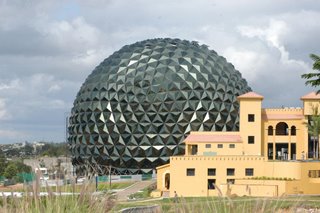 The skyline in this mini-city campus is dominated by a giant shimmering glass bubble and beside it is a moroccan style building in mellow yellow. This is a huge resort-like place which has swimming pools, restaurants, souvenir shops, gift shops, department store and also houses a Strand book stall.
Next stop was SDB1, Software Development Block One, a sleek and modern edifice facing the road; 650 Software Engineers carry on the development work for clients from across the globe.
Stepping out of the SDB1, the crimson and red hues of Sunset splattered in the sky was reflecting off the glass topped building and it seemed the building was surrounded by a golden red halo. Far across within the campus, a Tennis court, Helipad, the residential blocks and a floating restaurant stand among beautifully landscaped gardens. Grass, granite and glass seem to be the three main elements around which the entire architecture revolves. Not a speck of dirt could be seen anywhere; the roads were so clean that, a fellow visitor remarked, one could even sleep on it.
The entire campus is self-contained with a 2000 KVA generator, a water tank of 7 lakhs litre capacity, an affluent treatment & water recycling plant and an artificial lake with rain water harvesting incorporated.
World is once again at the door steps of Mysore after nearly half a century, and it is undoubtedly because of Infosys. I am a Mysorean, I feel proud. Thank you, Infosys.
Welcome to the truly world-class facility of Infosys Technologies Limited's Mysore Development Centre, 'My DC' as the Infosians here like to call it.
'Transforming business through integrated technology solutions' - this mantra aptly describes the goal of this software conglomerate, which has about nine Development Centres in India and approximately 70-80 offices across the globe with a work force of more than 13,000 employees of all nationalities.
The tea was served at the Infosys Leadership Institute, which has been built conforming to international standards. Soft sounds of water playing on granite fountains welcomed we visitors. 'Ranganathittu', 'Bandipur' etc are some of the names that are given to conference rooms here.
Promptly at 5.30 p.m. we were taken around the entire premises starting from the food-court. A lush green cricket ground sits snugly beside the food court from where almost a 1000 and odd crowd can watch the game and enjoy the food at the restaurant. A recreational wing, inside, houses a state of the art gymnasium, Table Tennis room, a Billiards & Snooker room and a rest room catering to the employees with a motto to keep them physically fit and thereby assuring their mental alertness. An ATM is also installed for convenience.
 The skyline in this mini-city campus is dominated by a giant shimmering glass bubble and beside it is a moroccan style building in mellow yellow. This is a huge resort-like place which has swimming pools, restaurants, souvenir shops, gift shops, department store and also houses a Strand book stall.
Next stop was SDB1, Software Development Block One, a sleek and modern edifice facing the road; 650 Software Engineers carry on the development work for clients from across the globe.
Stepping out of the SDB1, the crimson and red hues of Sunset splattered in the sky was reflecting off the glass topped building and it seemed the building was surrounded by a golden red halo. Far across within the campus, a Tennis court, Helipad, the residential blocks and a floating restaurant stand among beautifully landscaped gardens. Grass, granite and glass seem to be the three main elements around which the entire architecture revolves. Not a speck of dirt could be seen anywhere; the roads were so clean that, a fellow visitor remarked, one could even sleep on it.
The entire campus is self-contained with a 2000 KVA generator, a water tank of 7 lakhs litre capacity, an affluent treatment & water recycling plant and an artificial lake with rain water harvesting incorporated.
World is once again at the door steps of Mysore after nearly half a century, and it is undoubtedly because of Infosys. I am a Mysorean, I feel proud. Thank you, Infosys.
Thursday, October 26, 2006
Visit to AT&S at Nanjangud
Driving from Mysore towards Nanjangud, a little further from the bridge across river Kapila, a road to the right leads into the industrial area of Nanjangud which sits on the southern bank. This is where the 20 acre plot of the environment-friendly Austrian Technologies and Systems (AT&S) is situated amidst the verdant greenery.
This Printed Circuit Board (PCB) manufacturing unit was started as INDAL by Indian authorities in 1989. It was bought over by AT&S in 1999.
As soon as we enter the main gate, we are welcomed by three fluttering flags - the Indian tri-colour, the Austrian national flag and the AT&S flag. A faint chemical odour hanging in the air transports me back in time to my chemistry lab classes in college. Sniff, sniff, I strain to identify the chemicals and hurrah! One among them is Ammonia. But I fail to identify other chemical aromas romancing the air.
Friendly employees attired in navy blue and sky blue uniforms ushered us into the spacious canteen which had doubled up as nice meeting hall for the day. A quick sip of tea pepped us up and our small group of Rotarians, Rotaryannes, Rotaractors and Annets were given a guided tour around the campus by an employee. Two more groups had started early before us.
We first visited the environment section of the factory which houses the effluent treatment plant. Ninety percent of process during the manufacturing of PCBs involve water along with various chemicals and metals, some of which are hazardous. Thus polluted water is treated in this plant to remove all the impurities and render the water clean which is used to quench a thousand and odd trees and a nice garden in the campus.
The next stop was at the unit where the raw water drawn from the river is purified to be used in various processes. A generator room beside this unit houses three massive diesel generators which churn out enough electricity to feed the entire power requirement of the factory. Hence the campus is self sustained in electricity.
We then move indoors where the PCB is manufactured. We were allowed to peep into the designing section where multitudes of computer terminals were occupied by their human conterparts. In this section, the designs of PCBs , as given by the clients, are checked, corrected and converted into a language that is understood by machines doing the tasks. As we were curiously peeping into the glass windows, the human subjects on the other side looked amused and perhaps felt like fishes in an aquarium.
Next we were taken inside a long airconditioned hall which had complex machines each the size of a small car (sorry you can't drive them but rather they can drive a hole into you). They were drilling various sized holes into glass fiber epoxy laminate material (board) and creating a racket. Cacophony of the machines was because they were drilling at an incredible speed of 120,000 rpm (revolutions per minute), my gosh! Listening to it my head spun for a second at 120,000 rpm.
In the next section we saw the drilled boards being sandwiched between two thin copper foils between hot rollers (anyone for a hot sandwich or two?). Next the circuit diagram is printed on these boards with an acid resistant ink. Boards were rolled into a series of narrow acid baths of about 30-40 feet long bubbling with blue, green and clear liquids. Some of these machines were sporting cool red bulbs which were going off and on at random intervals. Liquids in these baths etch out excess copper except at the places protected by the resistant ink.
The boards go through many more such massive machinery and finally are subjected to gold electroplating where a very fine film of gold deposits on copper to prevent oxidation and thus providing a long life to the PCB. We were told that (hold your breath ladies!) a whopping 80 kilos of gold is consumed every month in this plant alone (ladies, dont you think that it is a sheer waste of yellow metal? I see many beautiful heads nodding in agreement).
The boards are taken onto cutting machines (if the PCB being manufactured is small in size, then usually five to six of them are produced on a single sheet of board) and cut to the required size and shape. Thus finished PCBs undergo complete tests, first electronic testing and later manual testing for scratches or abrasions. This manual testing was being done in a controlled environment under lens and microscopes by ladies. Dr. Maya Sitaram asked our guide why only ladies were employed to do the manual testing while ladies were present in none of the other departments. Mr. Keshav gave a tongue-in-cheek answer saying that ladies are good at finding faults (well, does that mean, men are good at making faults? hmm, I guess I am no Shobha De to answer that).
Finally we were at the packing section where each PCBs are bundled in tens, vacuum sealed and packed. Back at the meeting hall, in a formal meeting Rtn. Pradeep Mehta, MD and CFO, AT&S gave a few glimpses about the vision and organisation of AT&S which was followed by a multimedia presentation by Mr. Brown. Mr. Hegde, MD and COO, AT&S was present.
This Printed Circuit Board (PCB) manufacturing unit was started as INDAL by Indian authorities in 1989. It was bought over by AT&S in 1999.
As soon as we enter the main gate, we are welcomed by three fluttering flags - the Indian tri-colour, the Austrian national flag and the AT&S flag. A faint chemical odour hanging in the air transports me back in time to my chemistry lab classes in college. Sniff, sniff, I strain to identify the chemicals and hurrah! One among them is Ammonia. But I fail to identify other chemical aromas romancing the air.
Friendly employees attired in navy blue and sky blue uniforms ushered us into the spacious canteen which had doubled up as nice meeting hall for the day. A quick sip of tea pepped us up and our small group of Rotarians, Rotaryannes, Rotaractors and Annets were given a guided tour around the campus by an employee. Two more groups had started early before us.
We first visited the environment section of the factory which houses the effluent treatment plant. Ninety percent of process during the manufacturing of PCBs involve water along with various chemicals and metals, some of which are hazardous. Thus polluted water is treated in this plant to remove all the impurities and render the water clean which is used to quench a thousand and odd trees and a nice garden in the campus.
The next stop was at the unit where the raw water drawn from the river is purified to be used in various processes. A generator room beside this unit houses three massive diesel generators which churn out enough electricity to feed the entire power requirement of the factory. Hence the campus is self sustained in electricity.
We then move indoors where the PCB is manufactured. We were allowed to peep into the designing section where multitudes of computer terminals were occupied by their human conterparts. In this section, the designs of PCBs , as given by the clients, are checked, corrected and converted into a language that is understood by machines doing the tasks. As we were curiously peeping into the glass windows, the human subjects on the other side looked amused and perhaps felt like fishes in an aquarium.
Next we were taken inside a long airconditioned hall which had complex machines each the size of a small car (sorry you can't drive them but rather they can drive a hole into you). They were drilling various sized holes into glass fiber epoxy laminate material (board) and creating a racket. Cacophony of the machines was because they were drilling at an incredible speed of 120,000 rpm (revolutions per minute), my gosh! Listening to it my head spun for a second at 120,000 rpm.
In the next section we saw the drilled boards being sandwiched between two thin copper foils between hot rollers (anyone for a hot sandwich or two?). Next the circuit diagram is printed on these boards with an acid resistant ink. Boards were rolled into a series of narrow acid baths of about 30-40 feet long bubbling with blue, green and clear liquids. Some of these machines were sporting cool red bulbs which were going off and on at random intervals. Liquids in these baths etch out excess copper except at the places protected by the resistant ink.
The boards go through many more such massive machinery and finally are subjected to gold electroplating where a very fine film of gold deposits on copper to prevent oxidation and thus providing a long life to the PCB. We were told that (hold your breath ladies!) a whopping 80 kilos of gold is consumed every month in this plant alone (ladies, dont you think that it is a sheer waste of yellow metal? I see many beautiful heads nodding in agreement).
The boards are taken onto cutting machines (if the PCB being manufactured is small in size, then usually five to six of them are produced on a single sheet of board) and cut to the required size and shape. Thus finished PCBs undergo complete tests, first electronic testing and later manual testing for scratches or abrasions. This manual testing was being done in a controlled environment under lens and microscopes by ladies. Dr. Maya Sitaram asked our guide why only ladies were employed to do the manual testing while ladies were present in none of the other departments. Mr. Keshav gave a tongue-in-cheek answer saying that ladies are good at finding faults (well, does that mean, men are good at making faults? hmm, I guess I am no Shobha De to answer that).
Finally we were at the packing section where each PCBs are bundled in tens, vacuum sealed and packed. Back at the meeting hall, in a formal meeting Rtn. Pradeep Mehta, MD and CFO, AT&S gave a few glimpses about the vision and organisation of AT&S which was followed by a multimedia presentation by Mr. Brown. Mr. Hegde, MD and COO, AT&S was present.
Tuesday, October 17, 2006
Kaveri Teerthodbhava
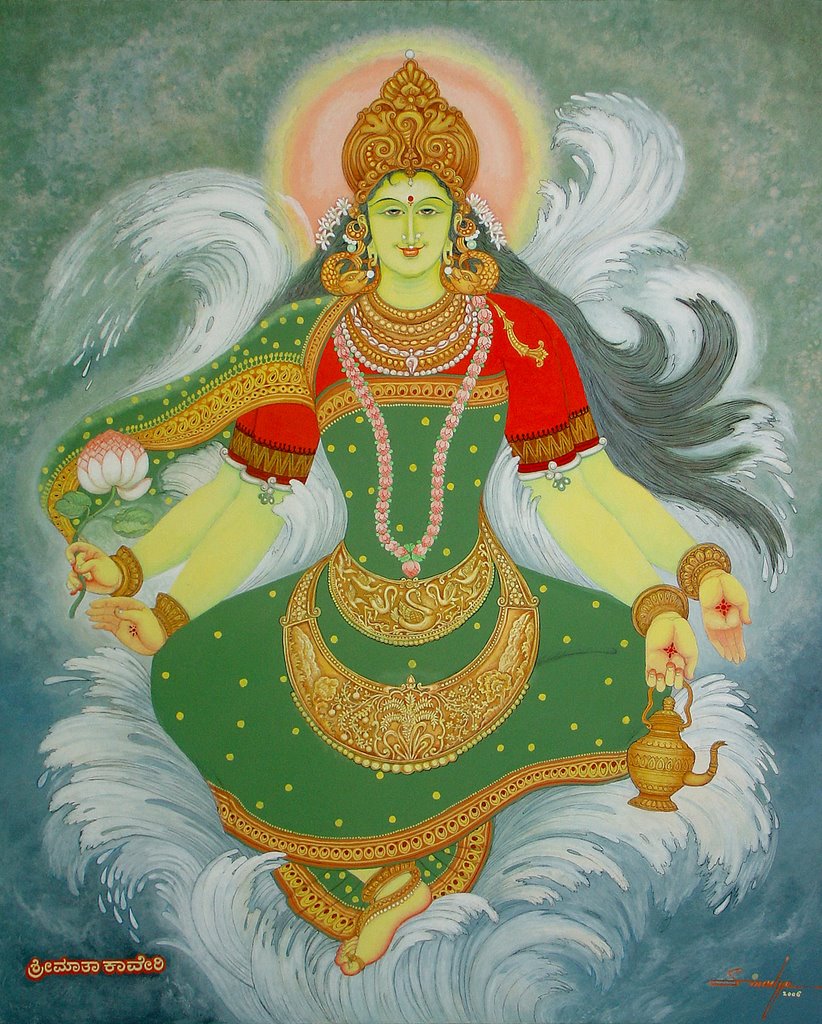
Painting: Sri Mata Kaveri
Medium: Gouache on board
Size: 20" X 24"
Artist: Sri G.L.N. Simha
Collection: Ramsons Kala Pratishtana
River Kaveri is the life line of millions in Karnataka, Kerala and Tamilnadu. She takes birth in the sylvan settings of Western Ghats amidst the picturesque hills Brahmagiri in the land of valiant Kodavas. Each year on the auspicious day of Tulasankramana (around 17th October) she spouts out of her tiny birthplace, at Talacauvery, as if reinvigorated and re-energised.
In the rich tapestry of Hindu mythology, each river has a legend about its birth and is depicted by a certain colour. Ganga is of the colour of sphatika, Godavari is shown in light brown colour while Kaveri is green in colour. Also Ganga is often shown descending from heavens and all other rivers are shown flowing, but it is only Kaveri who gushes out of earth in the form of a spring.
The artist has depicted goddess Kaveri as green in colour. She has draped a rich green saree in the typical Kodava fashion. She is adorned with a high crown, matsya-kundalas, necklaces made of gold, pearls, cowries and lotuses. She wears a waist girdle depicting the avian creatures found all along her course and the vaijayanthi is shown with golden paddy, succulent oranges, vegetation and landscapes which are nourished by her life giving waters.
Two of her hands are shown in abhaya and varada mudras, in the third she holds a kamandalu while in the fourth she holds a beautiful lotus. The goddess is depicted as springing up on vigorous waves surging from beneath. The faint smile on her green visage is reassuring and beautiful.
Among the creative and talented artists of Mysore, Sri G.L.N. Simha occupies a special place as he has pioneered painting based on dhyana shlokas, veda mantras and suktas. This painting has been commissioned by Ramsons Kala Pratishtana as a part of the series of paintings on myths, legends, fairs and festivals of Karnataka by several artists.
Subscribe to:
Posts (Atom)